
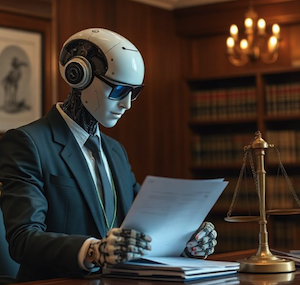
 Artificial intelligence is rapidly changing the way we function in life. This author relied heavily on Google Gemini and ChatGPT when building our new law firm from the ground up in the Law and Finance Building. AI helped with everything from building the corporate structure of the new company, to selecting a location downtown and getting our high-speed copier to work!
In our litigation practice, AI helps us research and write briefs for use in court. We routinely rely on AI for a first draft of briefs and motions, for example. AI organizes information and saves time. It also summarizes conversations with clients to develop the factual background and legal strategy in a case. Judges and their law clerks rely on AI to draft opinions.
Anyone — including non-lawyers — can ask AI anything: draft me a complaint to file in court to start my civil law suit. Or, tell me the legal issues involved. What should I say in court? Will I win?
The results will sound and look very impressive.
The non-lawyer may wonder: why spend $300 per hour on a lawyer when AI instantly drafts legal looking documents and gives me great sounding advice for free?
The answer is simple: perception can differ from reality.
A recent decision from the Pennsylvania Superior Court illustrates the problem.
Kaspryak v. Stadarskyy, 2026 PA Super 185 (Pa. Super. Ct. 2026)
In Kaspryak v. Stadarskyy, a party proceeding pro se (without a lawyer) tried to force a sale of a home they co-owned with the Defendant. Plaintiff filed a “partition” action, which is the correct way to proceed, but it has nuances that a lawyer should navigate. Still, at least initially, things went very pretty well for the pro se Plaintiff. For example, she filed the correct type of complaint to get the matter before a court. The court ruled on the matter without dismissing it on a technicality.
But ultimately, the court ruled against the Plaintiff.
So plaintiff decided to appeal to the superior court.
There, still without a lawyer, the Plaintiff filed a competent appeal, which is no easy task, given the procedural rules involved, which can challenge even the most experienced lawyers. And yet the Plaintiff advanced her appeal well, without it getting dismissed on a technicality.
But when the Superior Court heard the case — and looked more closely at the appeal — things unravelled for the Plaintiff, once again.
The Plaintiff relied on various cases and statutes, likely suggested by AI. Unfortunately, some of the authorities did not exist as cited. Others were cited under incorrect names. Still others did not support the legal propositions for which they were offered.
For example, the appellant cited:
“General Fin. Co. v. Archetto, 167 A.2d 306 (Pa. Super. 1961)”
The problem was that the citation did not correspond to the case identified in the brief. Instead, the citation led to an entirely different case from the Pennsylvania Supreme Court. And it wasn’t just one mistake: it was all the plaintiff’s citations.
The Superior Court referred to these types of citations as “hallucinated citations.” But hallucinations are not the only problem. AI is not a lawyer. It did not go to law school. It can only tell you what the internet has to say about a legal topic. Problem is, much of that information is incomplete, making AI guess at the answer. Or it comes from lawyers who primarily write articles for a living, lacking true legal experience.
As the expression goes: garbage in, garbage out.
That is a significant warning for anyone using generative AI for legal research or document preparation for use in court.
A Citation Is Not Authority Merely Because It Looks Like One
One of the most important lessons from Kaspryak is simple: every legal citation must be independently verified.
 Generative AI systems can produce citations that look authentic. They do so because they generate text based on patterns learned from enormous amounts of information. However, the system does not necessarily know whether a particular combination of a case name, reporter volume, page number, court, and year corresponds to an actual judicial decision.
Even more importantly, a case may exist but still not support the proposition for which it is cited.
Therefore, a lawyer — much less a client proceeding without a lawyer — cannot responsibly cite a case simply because its name or language appears relevant. The litigant must locate the actual opinion, read it, understand what the court decided, and determine whether it applies to the issue being presented.
The litigant must also determine whether the decision is binding (precedential) or merely persuasive (non-precedential). In addition, the lawyer should determine whether the case has been limited, distinguished, or overruled.
That process is the essence of legal research and analysis.
Statutes Demand the Same Scrutiny
The Kaspryak decision also demonstrates why lawyers must read statutes rather than simply relying on an AI-generated description of what a statute supposedly says.
The appellant argued that Pennsylvania’s Statute of Frauds imposed a particular recording requirement. However, the Superior Court explained that the statute did not contain the requirement asserted by the appellant.
So how could AI get this so wrong?
There are many ways to misconstrue a statute. For example, a statute may have been amended without anyone blogging about it.
So when our lawyers use AI to write articles or briefs, we always add a prompt: give me the exact statutory language and the link to the statute itself so I can read it. Don’t tell me what you think it means. Let me read it.”
The takeaway: never assume that a statute says what an AI system claims it says.
Lawyers are Constantly Teaching AI Models
AI’s greatest strength is simple yet powerful: it has the ability to learn, autonomously. The best learning comes from evaluating a problem, guessing at the solution, seeing if the guess (or hunch) proved useful in reality, then refining one’s strategy based on the new knowledge discovered through trial and error.
It’s no surprise that AI — being very smart — enthusiastically offers its best guess when giving you an answer.
But that’s all it is: an educated guess based on a good faith search of the internet, which is an excellent starting point for the development of knowledge.
AI — like any truly smart person — wants to be corrected.
As lawyers, we’re constantly correcting the results we get from AI. For example, we might say: “Wait, AI, aren’t you assuming something. Take away the assumption.”
AI will often correct itself, “yes, changing the assumption changes our discussion. Here’s the new recommendation…”
With this, AI keeps learning — at an astounding rate.
But along the way, AI will continue to make mistakes, which are harmless, as long as you know:
- when to question and
- how to question it.
Best Use of AI: Collaboratively
Like humans, AI can work tremendously well in a collaborative environment, where the participants take an active role in scrutinizing and correcting the assumptions made, leading to solid and reliable conclusions. For example, when we ask AI: how much is my client’s injury case case worth? AI might say: “$50,000.” But jury verdicts tend to be significantly higher in Philadelphia PA than in Pittsburgh, for example.
AI might assume it know the venue.
So you need to press AI about its results: how much is it worth “in state court in Pittsburgh”? The answer might be: $20,000.
What about in “state court in Philly”? Answer: “$80,000.”
These AI responses are much more accurate.
So with a better prompt — one that takes into account one’s own specialized information gathered from practicing law for decades — AI’s results become more reliable.
Bottom line: unless you know how to challenge AI’s assumptions (here, regarding venue), you will likely get inaccurate information from AI’s first guess at the answer.
The problem is, for the non-lawyer, it’s difficult — if not impossible — to take an active role in this process without a base of specialized knowledge or legal experience, which is needed to challenge and improve AI.
And there’s where a litigant — who blindly relies on AI — can get into trouble: big trouble.
You can both lost your case in court and face penalties and sa for blindly relying on AI.
The Hidden Cost of “Free” Legal Advice.
Our office recently handled an example of this problem.
We defended a woman sued by her ex-boyfriend, claiming she had wrongfully taken property that belonged to him. The ex-boyfriend never retained a lawyer to advance the case. His complaint appeared to have been generated using ChatGPT. The document had the unmistakable appearance of an AI-generated pleading, including the characteristic formatting of its headings and use of color. We filed a motion for sanctions, claiming this was unfair: why should our client have to pay a lawyer to explain why some or all of a lawsuit is frivolous, when the non-lawyer Plaintiff blindly relies on “free” advice from AI?
Ultimately, the non-lawyer was forced to drop his case without having his day in court. He did this to avoid paying our client’s attorney fees throughout the process.
The frustrating part was that his complaint could have been a useful first draft. It identified some of the basic facts and issues. However, it had apparently been filed without the critical next step: having a lawyer review it, research the applicable law, correct the legal deficiencies, and determine whether the claims could actually be pursued.
As a result, what might have been a productive starting point became a legally defective pleading—and ultimately led to litigation over the filing itself.
That experience illustrates an important point:
AI can reduce the cost of creating words. It cannot eliminate the cost of getting the law wrong.
And when the stakes involve a lawsuit, the cost of correcting a mistake can be far greater than the cost of getting competent legal advice in the first place.
Conclusion
AI can create a useful first draft of most types of legal documents. Kaspryak addressed the use of inaccurate and “hallucinated” legal authorities. Unless you have the training and/or experience to challenge AI’s suggestions to your legal problem, you can get into real trouble. You can not only lose your case, but also face sanctions for wasting the court and opposing party’s time.
Let’s Get Started!
Contact our attorneys today!
412.342.0992