
 Have you received notice of an actual (or impending) default judgment against you in a civil case in the Court of Common Pleas in Pennsylvania? If so, contact a lawyer immediately, because every minute counts. In this article, we explore default judgments and how to open or strike one — assuming it’s not already too late!
What is a Default Judgment?
A default judgment often means “game over” for the Defendant, because it proves the Defendant’s liability without a trial, or any evidence whatsoever being offered. The basis is simply the Defendant’s failure to timely respond to the suit. And, if the Plaintiff seeks a specific amount of money (such as $5,000, $50,000 or $5,000,000), the default judgment will be for that amount, and the Plaintiff can immediately start executing on the Defendant’s assets.
 For example, let’s say your neighbor claims he gave you $100,000, expecting to be paid back, but you failed to do so. Your neighbor files a Complaint in PA state court, demanding $100,000. But you fail to respond, resulting in a default judgment against you for $100,000. Perhaps you have some great defenses to the Complaint. Maybe you had earned the money, by helping build your neighbor’s house! Or maybe the statute of limitations had long since expired, prior to your neighbor filing his Complaint.
Regardless, your neighbor can use his default judgment entered in the Court of Common Pleas to immediately start executing on your assets, such as bank accounts and even your home, in certain instances, until your attorney takes immediate action and gets the judgment stricken or opened. The judgment can create and automatic lien against your real property, until actually opened or stricken. See 231 Pa. Code Rule 2959 (a)(3)(f).
Contact Us Today!
Call, email, or read on (below) if a default judgment is threatened or has been taken against you.
412.342.0992
How Does a Default Judgment Come About?
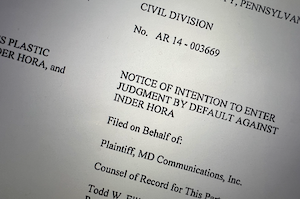 In PA state court (the Court of Common Pleas), the defendant has twenty (20) days to file a written response to a civil Complaint, when served with it by sheriff (if you live in PA) or by certified mail (out-of-state Defendants). See Pa.R.C.P. 237.3. Otherwise, the Plaintiff can then serve the defendant with a 10 day notice of intent to get a default judgment, giving you a total of thirty (30) days from the date of service to respond to a complaint filed against you in PA state court.
Then, the Plaintiff can then take a judgment by default without further notice, if you still haven’t filed a response to the complaint. And, unless you hire an attorney to promptly file a petition to open or motion to strike the judgment, the judgment may stand, even if the lawsuit was baseless and/or there exists some defect in the paperwork against you.
Let’s talk about a petition to open, first, because it’s the simplest and most surefire method to obtain relief from a default judgment, if filed timely. Then, we will discuss a motion to strike the default judgment.
Petition to Open a Judgment by Default
The court must open a default judgment, if the Defendant (1) files within ten (10) days a Petition to Open and (2) attaches to the Petition a verified answer (denying some or all of the allegations) or something called “preliminary objections,” stating a meritorious defense to the claims in the Complaint. See Pa.R.C.P. 237.3(b)(2).
Calculating the “Ten Day” Period. The Defendant has ten (10) days from when the default judgment was mailed to the Defendant not the date it was received. Plus it’s ten calendar days, not business days.
So, for example, if the post office takes seven days to mail the default judgment to the Defendant, then, the Defendant may only have as little as three days to both (1) hire a lawyer and (2) file a timely petition to open the judgment.
Filing a Petition to Open After Ten Days. After ten days, the process to open the judgment becomes significantly more challenging and uncertain. Allegheny Hydro 1 v. American Line Bldrs., 722 A. 2d 189 (Pa.Super. 1998). Specifically, after ten days, the Defendant must prove three things to the motion’s judge’s satisfaction:
1. Prompt Petition. If you’re the defendant, you must show that you filed the request quickly after learning of the judgment. What counts a “prompt” is up to the discretion of the motion’s judge in your case, but in the past, some judges have held:
-
-
-
- Twenty-one day delay is not prompt, See B.C.Y., Inc. Equipment Leasing Assocs. v. Bukovich, 257 Pa.Super. 121, 390 A.2d 276, 278 (Pa.Super.1978);
- Thirty-seven days is not prompt, Hatgimisios v. Dave’s N.E. Mint, Inc., 251 Pa.Super. 275, 380 A.2d 485, 485 (Pa.Super.1977); and
- Five-day delay is timely, see Fink v. General Accident Ins. 194 Co., 406 Pa.Super. 294, 594 A.2d 345, 346 (Pa.Super.1991).
-
-
2. A Reasonable Excuse: A valid reason for your delay (e.g., the postal service lost the notice of judgment in the mail and you never received it). However, courts have deemed the following as unreasonable excuses:
-
-
-
- Attempts to informally resolve the matter by asking opposing counsel to voluntarily open judgment is not a reasonable excuse for the forty-one day delay. See Pappas v. Stefan, 451 Pa. 354, 304 A.2d 143, 146 n. 3 (Pa.1973).
- A defendant’s failure to file an answer because of a mistake as to the law or facts, such as mistakenly assumed opposing counsel granted an extension of time to respond to petition to open the judgment. See McEvilly v. Tucci, 239 Pa.Super. 474, 362 A.2d 259, 262 (Pa.Super.1976).
-
-
3. A Meritorious Defense: A valid reason to contest the allegations factually or as a matter of law. You should talk to a lawyer about this, however, before filing anything.
But you never know exactly what any particular judge will do with any given petition to open a default judgment, if filed beyond the ten (10) day window.
For example, recently, on October 10, 2025, a judge in Lycoming County indicated he would have opened the judgment, even if the petition had been filed beyond the ten (10) day window. See Susquehanna Legal Aid For Adults & Youth v. Winkleman, No. CV-2024-01041 (C.P. Lyc. Co. Sept. 23, 2025 Carlucci, J.). There, the party who had taken a default judgment knew an aggressive defense was coming, even as they filed the default judgment, as the case had been hotly contested and litigated for months previously, which is a fairly unique situation.
Motion to Strike a Default Judgment
-
 Failure to properly serve the lawsuit; it must be done via hand delivery by sheriff (in PA) or by certified mail (outside of PA),
 - Failure to serve a ten day notice of intent to seek a judgment by default, or mailing it to the wrong address, such as an address different from the address of record for the Defendant (where he was served with the original process),
- Failure to serve a valid notice to plead to alert the Defendant to his obligation to defend the case and file a response within twenty days, or
- Failure to calculate the correct amount of money on the judgment, if any. For example, in a claim for non-economic losses — such as pain and suffering, embarrassment and humiliation, or loss of ability to enjoy the pleasures of life — it’s improper to list any particular dollar value for such damages in a Complaint in PA. Thus, in such instances, the default judgment will only prove liability, but not a particular dollar amount for non-economic damages; rather, a separate hearing is needed, to prove the value of “non-economic damages,” such as “pain and suffering,” even if there’s a default judgment. See Pa.R.C.P. 1037.
Key Takeaway
If you miss the 10-day window to open, your burden increases significantly, as you must prove both a legitimate excuse and a meritorious defense to convince the court to set aside the judgment. Or, you must show some fatal procedural defect in the default judgment, which may be difficult or impossible. Interest accrues on PA judgments at 6% per annum from the date of judgment. You should get an experienced lawyer involved as early as possible. These procedural rules present a minefield for lawyers and non-lawyers, alike.
Is it the Same As a Confession of Judgment?
No. These are very different types of judgment. A confession of judgment only applies in commercial settings and the debtor agrees to waive prior notice of the confession of judgment. Click here for a full comparison.